2026-05-26
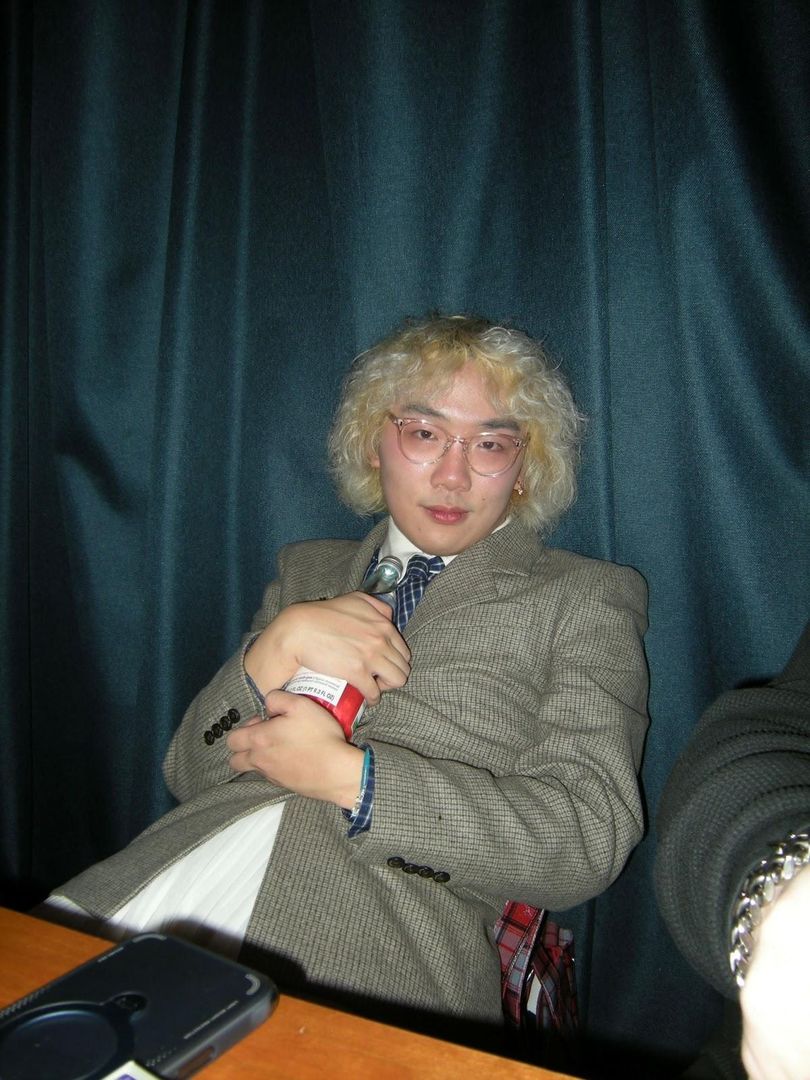
Lauren Rodriguez
Design Dispatch, New York
At ICA VCU, an artist transforms the cold machinery of state administration into a meditation on human closeness — and asks whether a waiting room can make two strangers hold hands.
There is a particular quality of time inside a government office — neither moving nor entirely still, held in suspension by fluorescent light and the low mechanical hum of bureaucratic procedure. It is time experienced as accumulation rather than passage. Rasim Bayramov, an Azerbaijani artist completing his MFA in Graphic Design at Virginia Commonwealth University, made this temporal texture the medium of his spring thesis exhibition at ICA VCU — and asked whether, within its hostile conditions, two strangers might reach across the divide and hold hands.
The question is disarming precisely because it refuses irony. This is not institutional critique performed from a safe critical distance. Rasim is not sitting in an office chair. The bureaucratic encounter, for an artist shaped by post-Soviet Azerbaijan, carries a weight that Western conceptual practice rarely has to metabolize — the intimate knowledge that systems of governance and delay are not abstractions but atmospheres, the air one breathes at home, at the border, in the queue that has no discernible end.
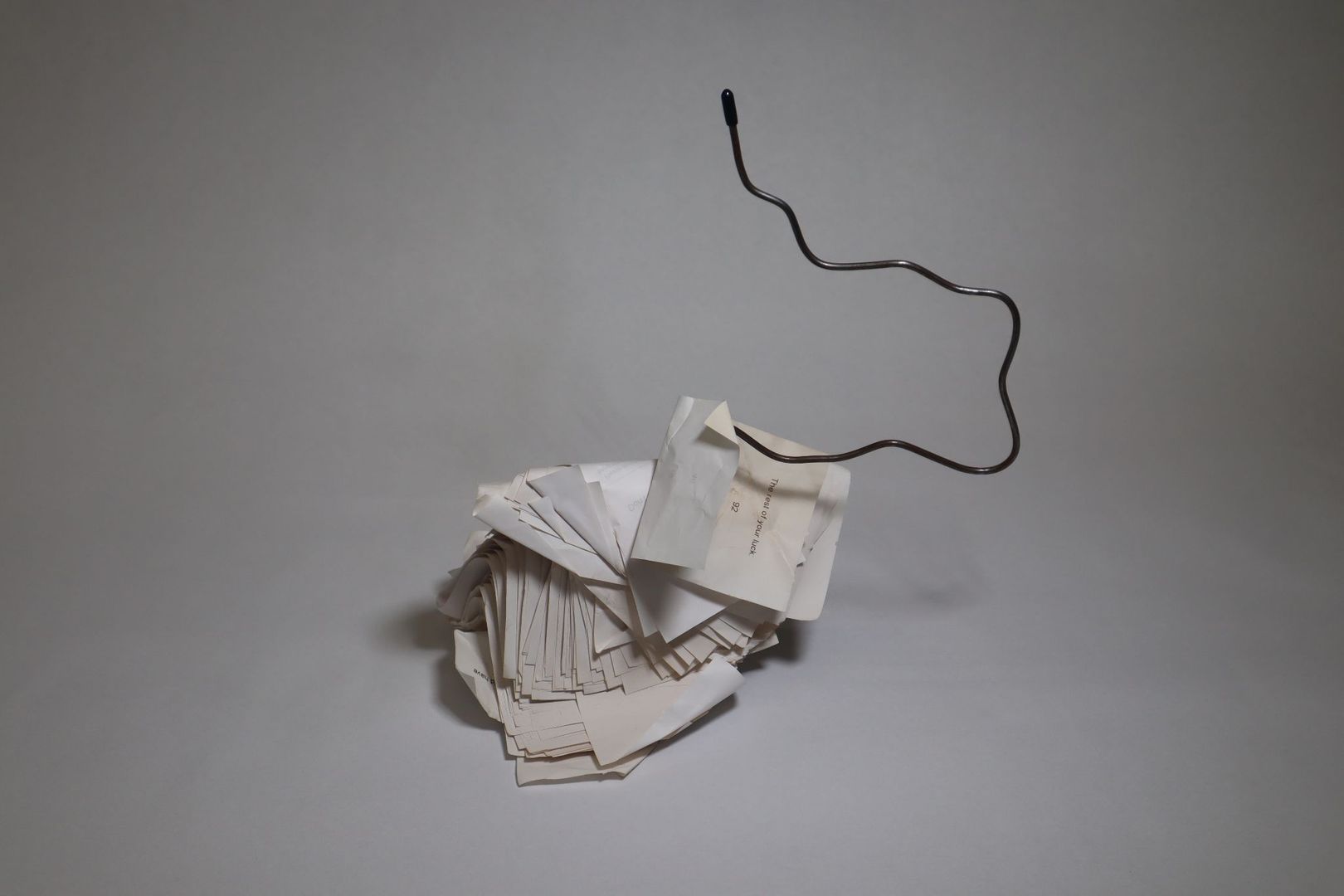
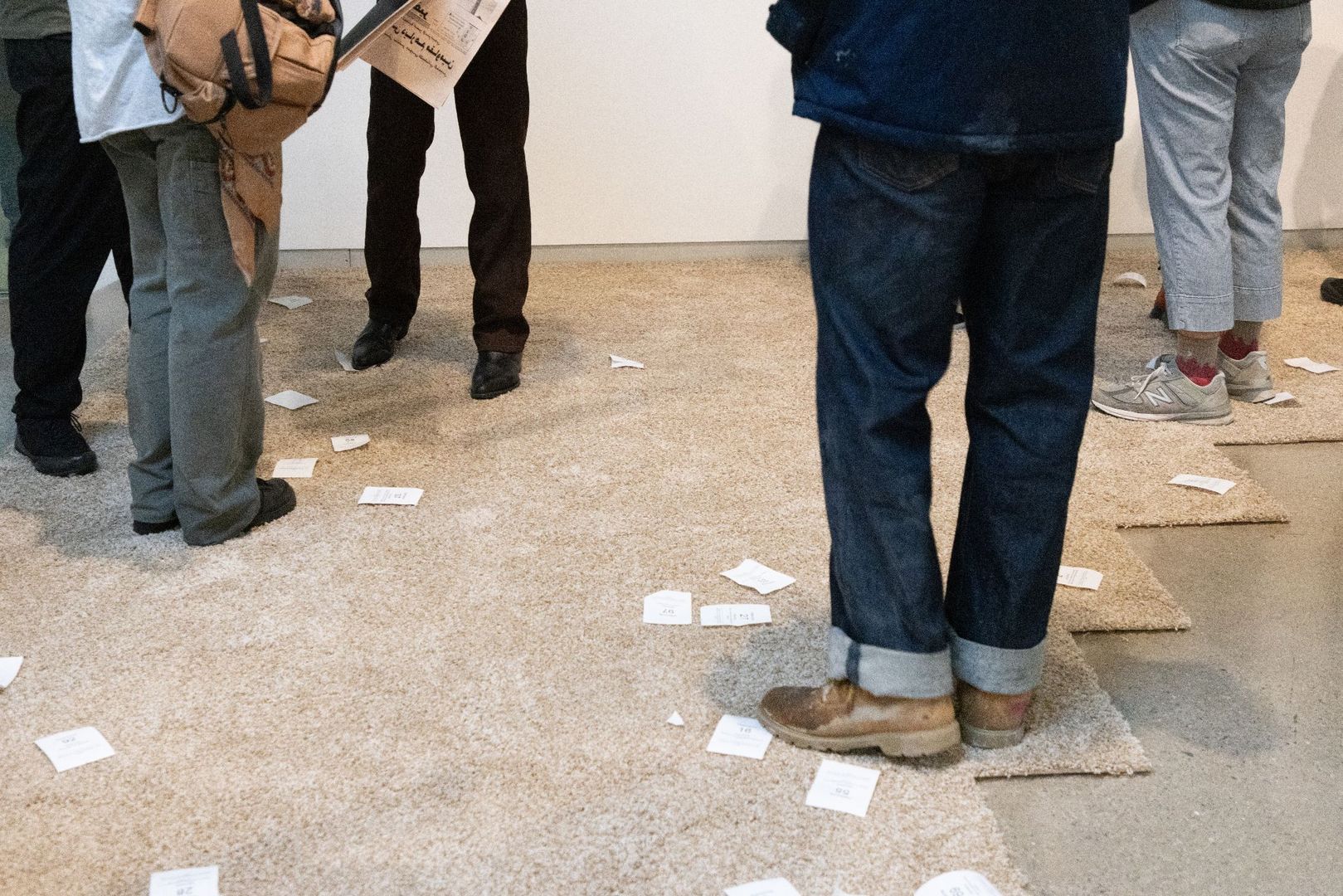
The exhibition began before it began. Visitors did not enter a gallery so much as report to one. At the threshold, a simulation of a civic checkpoint converted each arrival into an applicant — a petitioner presenting themselves to an institutional process whose logic remained unstated. A receipt was issued. This small paper object — mundane, disposable, entirely without market value — became the first material proposition of the work: that documentation is also a form of recognition, that to be processed is, however coldly, to be acknowledged.
This move, positioning the viewer as subject rather than spectator, is well-trodden ground in relational and institutional critique. What distinguished Bayramov's handling of it was the emotional register — less confrontational than melancholy, more interested in what the bureaucratic encounter costs at the level of longing than what it reveals at the level of power.
The waiting room itself was, in the artist's own phrasing, "a proportionally blown out version of an aimless waiting space." The phrase is telling. Not a replica, not a critique, not a parody — a dilation. The space expanded the logic of waiting until it became perceptible as architecture, until the ambient dread of the anteroom achieved a kind of grandeur. Objects referenced what Bayramov calls the "peculiar afterlife" of Soviet-era production: technologies misapplied, national industries nationalized into obsolescence, the material culture of a system that trained its citizens, across generations, to wait as a primary mode of existing in the world.
The reference points here are multiple and do not resolve into a single lineage. One thinks of Ilya Kabakov's communal apartment installations, with their bureaucratic paperwork and abandoned personal effects. One thinks of the Eastern European tradition of absurdist theater — Kafka domesticated into architecture. But Bayramov's work declines to be sardonic. The waiting room retains what he describes as enchantment: it is a space of play, of suspension, of what might be possible precisely because nothing has yet been decided.
The governing metaphor Bayramov offers is the asymptote — that curve in mathematics that perpetually approaches its limit without ever achieving contact. Two hands reach across a shoreline. The gap between them narrows by degrees. They do not touch. Yet the approaching itself is the event; the motion is the meaning.
"On the other side of the coast, a hand is waiting," he writes in the accompanying text. "This space between you and them is an asymptote." The formulation carries a quiet devastation. It refuses consolation — the hands will not meet — while insisting on the generative quality of the approach. The waiting space is cold, but the salt of the sea will eventually warm the extended hand. The bureaucratic chill and the human warmth are not opposites to be resolved but conditions held simultaneously, in tension that does not seek release.
This is where Bayramov's work seems most original. The critical literature on institutional critique tends to position the institution as something to be exposed, circumvented, or dismantled — power made visible and therefore diminished. Bayramov proposes something stranger: that within the processing of persons through systems of delay and documentation, within the very architecture of deferral, something tender might be found. Not despite the bureaucracy, but through its own distorting logic.
As the installation came down and the simulated checkpoint was dismantled, what persisted was the question itself — hanging, asymptotic, still reaching. Bayramov's project is ultimately less concerned with bureaucracy as a site of critique than as a site of transformation: a space where the reduction of persons to case files might, under the right pressure and with sufficient tenderness, give way to something else entirely. The reception desk cleared. The receipts, somewhere, accumulated. Somewhere, two hands remained extended across a diminishing distance, not yet touching, not giving up.
The exhibition functioned as the culmination of what Rasim describes as a "two-year conversation with objects, spaces, people, emotions, places, and memories." This conversation extended into a parallel publication designed to be experienced in pairs—a book meant to be read simultaneously by two people, apart but always linked. Its pages alternate between images of work, writings, and what the artist terms "extracurriculars"—the ephemera of a life lived between systems. There is no prescribed order, only the insistence on connection. “You go, I will wait” will be available this summer through Triple Junction Press.
This gesture of paired reading encapsulates the project's central paradox: that bureaucracy, which reduces individuals to documents and case numbers, might also provide the framework for genuine intimacy. The receipt, the checkpoint, the waiting room—these are not obstacles to connection but perhaps its preconditions. In a world where power operates through systematic accumulation, the act of waiting together becomes a form of resistance.